AGI Is Here: What It Means for Your Business in 2026
The debate is over. Whether you call it AGI, functional AGI, or "long-horizon agents," artificial intelligence has crossed a threshold that changes everything. Here's what smart business leaders are doing right now.
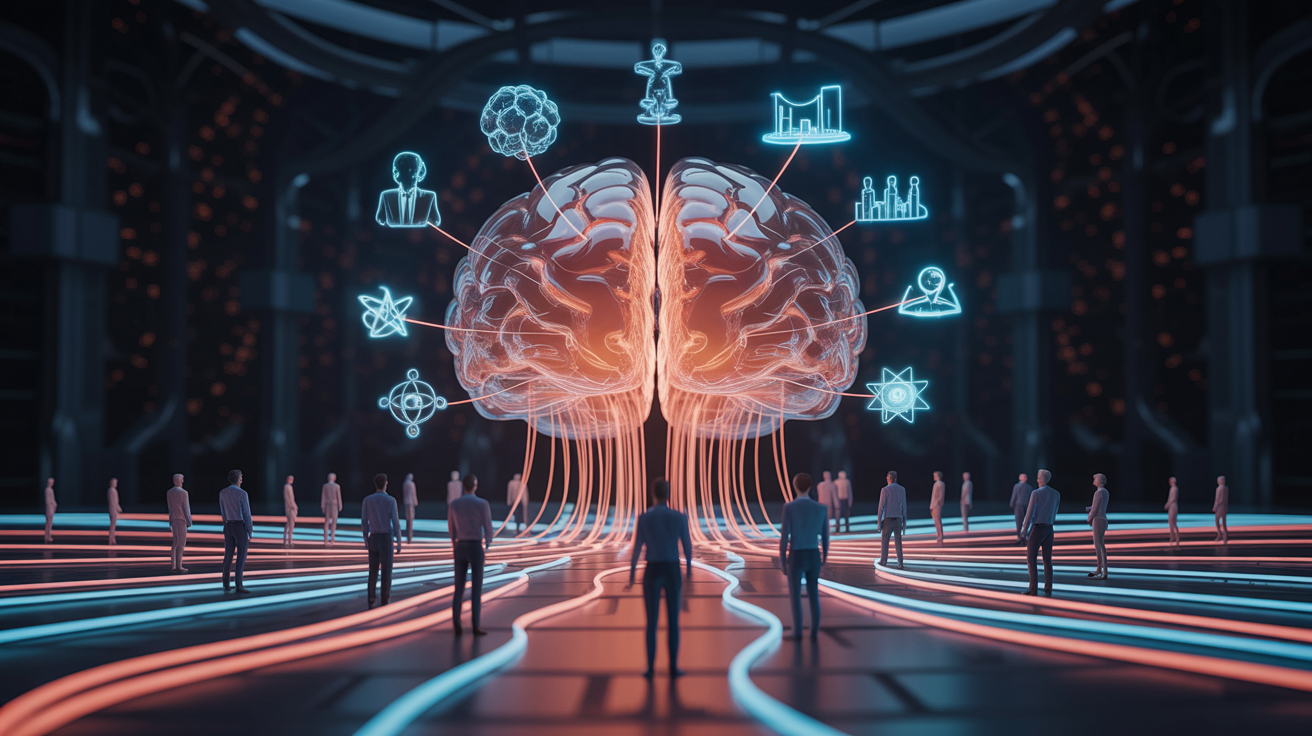
The Moment Has Arrived
In January 2026, Sequoia Capital—one of the most respected voices in tech investing—made a bold declaration: "AGI is here, now." They weren't talking about some distant sci-fi future. They were describing what's happening in boardrooms and businesses today.
The definition they use isn't academic—it's functional. AGI, in practical terms, means AI systems that can "figure things out." Systems with baseline knowledge, reasoning capabilities, and the ability to iterate on problems without being told every step. Systems that make and fix their own mistakes.
Chance of AGI by 2029 (forecaster average)
Time for agent task capacity to double
Of routine tasks automatable by 2027
What "Functional AGI" Actually Means
Forget the Hollywood version of AGI—sentient robots with emotions. What's arrived is more practical and, arguably, more transformative for business: long-horizon agents.
These are AI systems that can:
- • Take on complex, multi-step projects autonomously
- • Work for extended periods without human intervention
- • Make decisions, encounter errors, and self-correct
- • Determine what tools and resources they need
- • Iterate until a task is genuinely complete
The data is striking: agent capabilities are doubling every 7 months. By 2028, Sequoia predicts agents will be able to perform a full day's worth of human expert work. That's not gradual change—that's exponential transformation.
Reasoning at Scale
AI systems now reason through complex problems, not just pattern-match. They can plan, strategize, and adapt approaches mid-task.
Goal-Directed Autonomy
Given an objective, agents determine their own path—choosing tools, gathering information, and executing without step-by-step instructions.
Self-Correction
When something fails, agents diagnose the problem and try alternative approaches—mimicking the human debugging process.
Continuous Learning
Systems improve from experience, building knowledge that compounds over time and across tasks.
The Two Futures: Where Does Your Business Land?
Economists and technologists describe two possible scenarios for the next few years:
Scenario 1: Economic Singularity
AGI triggers a rapid transformation. Within this decade, AI systems perform most cognitive work. The economy restructures fundamentally. Massive infrastructure investment. Career transitions measured in months, not years. First movers capture disproportionate value.
Scenario 2: Normal Technology Adoption
AI is powerful but follows typical adoption curves. Diffusion takes decades, not years. Some industries transform quickly; others absorb AI gradually. Augmentation dominates replacement. Change is significant but manageable.
Here's the strategic insight: the prudent play is to prepare for Scenario 1 while accepting Scenario 2 as a floor. If you're ready for rapid transformation and it happens slowly, you're ahead of competitors. If you're prepared for slow adoption and transformation accelerates, you're caught flat-footed.
The Waiting Trap
Many executives are waiting for a clear "AGI benchmark" before acting. This is a strategic error. Current AI capabilities are already powerful enough to disrupt industries. The companies deploying AI agents today are building advantages that compound daily.
Your AGI Preparation Playbook
The 5-Point Business Transformation Framework
Stop treating AI as a supplementary tool. Restructure workflows around AI capabilities. The question for every process should be: "Why isn't this AI-native?"
AGI systems require comprehensive access to clean, organized data. Companies with fragmented data across siloed systems will be unable to leverage advanced AI capabilities. Consolidate and structure your data as if your business depends on it—because it does.
The new critical skills: AI tool proficiency, data literacy, AI output quality assurance, and strategic decision-making. New roles will emerge around AI supervision and human-AI collaboration.
Start with well-defined tasks: customer service, inventory management, lead qualification, financial reconciliation. Learn to manage AI agents now, while the stakes are lower.
As AI autonomy increases, so do questions of responsibility, compliance, and oversight. Establish governance frameworks before regulations force your hand.
What Changes by End of 2026
Based on current trajectories and expert forecasts, here's what businesses should expect:
AI coding reaches human-expert level. Custom software becomes dramatically more affordable. Routine development tasks shift entirely to AI.
AI can complete tasks that take humans 39+ hours (a full work week) in under an hour. Businesses that don't adapt face severe competitive disadvantage.
AI systems execute week-long projects with minimal human oversight. The management challenge shifts from task execution to AI supervision.
Customers expect personalized, instant service. AI-powered businesses deliver it. Those relying on human-only operations fall behind on service quality.
The Skeptic's Perspective
Not everyone agrees that AGI has arrived. Researchers like Gary Marcus argue that current systems, however impressive, are "sophisticated statistical approximations" rather than genuine intelligence. Stanford's James Landay flatly predicted "no AGI in 2026."
These critiques have merit—current systems still fail in reliability, robustness, and certain types of reasoning. But here's what matters for business: the functional capabilities exist regardless of what we call them. Whether it's "true AGI" or "very advanced narrow AI" is an academic distinction. The business impact is the same.
The Bottom Line
Something fundamental has shifted. AI systems can now figure things out. They can take on complex projects, work autonomously, and improve over time. Whether this meets a philosopher's definition of "general intelligence" matters less than what it means for your business.
The executives who thrive in 2026 and beyond will be those who treat this moment as the strategic inflection point it is—restructuring operations, upskilling teams, and deploying AI agents while competitors debate terminology.
AGI is here. It's real. The only question is: what's your plan?
Build Your AGI Strategy
LAcreativeAI helps businesses deploy autonomous AI systems and transform operations for the AGI era.
Book a Strategy CallThis article synthesizes insights from Sequoia Capital, Stanford HAI, MIT, Council on Foreign Relations, O'Reilly, and Marketing AI Institute research on AGI timelines and business implications. Inspired by Liam Ottley's analysis on AGI preparation strategies.